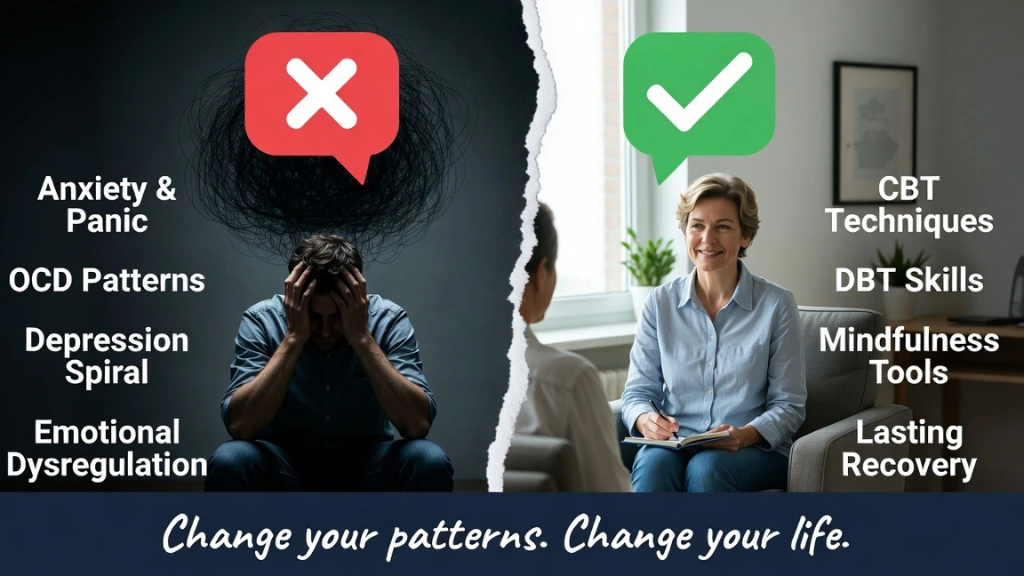
Behavioral therapy is one of the most widely used and well-researched approaches in mental health treatment today. At its core, it’s built on a straightforward but powerful idea: behaviors are learned, and what has been learned can be changed. Unlike approaches that focus primarily on exploring the past, behavioral therapy is action-oriented — it targets the patterns of thinking and behavior that are causing problems right now and works to replace them with healthier ones.
For people dealing with depression, anxiety, OCD, ADHD, eating disorders, or substance use issues, behavioral therapy can be a genuinely life-changing component of care.
What Behavioral Therapy Actually Does
Behavioral therapy helps you identify patterns of thought and behavior that are working against you — avoidance, negative self-talk, compulsive responses, emotional dysregulation — and then teaches you concrete strategies to change them.
It doesn’t ask you to simply think more positively. It gives you structured tools and practiced techniques that rewire how you respond to the situations, people, and emotions that trigger your symptoms.
The focus is on the present. While understanding the past has value, behavioral therapy asks: What is happening now, and what can we do about it?
Types of Behavioral Therapy
Behavioral therapy is an umbrella term covering several distinct approaches. Each has its own framework and is better suited to certain conditions and goals.
Cognitive Behavioral Therapy (CBT)
Cognitive behavioral therapy is the most widely practiced form of behavioral therapy in the world, and among the most extensively studied. It works by examining the relationship between your thoughts, feelings, and behaviors. When you identify distorted or unhelpful thought patterns — known as cognitive distortions — and learn to challenge and reframe them, your emotional responses and behaviors often shift significantly alongside.
CBT is highly effective for depression, anxiety disorders, panic disorder, OCD, eating disorders, and PTSD.
Dialectical Behavior Therapy (DBT)
DBT was originally developed to treat borderline personality disorder but has since proven effective for a broad range of conditions involving emotional dysregulation, self-harm, and chronic suicidal ideation. It combines cognitive-behavioral techniques with concepts of mindfulness and acceptance.
DBT is structured around four core skill areas: mindfulness, distress tolerance, emotional regulation, and interpersonal effectiveness. Patients learn practical skills they can apply in real-life situations when emotions become overwhelming.
Acceptance and Commitment Therapy (ACT)
ACT takes a different angle. Rather than directly challenging negative thoughts, it teaches patients to accept difficult thoughts and feelings without letting them control behavior. The commitment piece involves identifying personal values and taking action aligned with those values — even in the presence of discomfort.
ACT is particularly effective for anxiety, chronic pain-related psychological distress, and depression.
Cognitive Behavioral Play Therapy
For younger patients, play therapy allows a therapist to observe and engage with a child’s inner world through play — which is a child’s natural language. Therapists can identify fears, anxieties, and behavioral patterns that a child may not be able to verbalize. Parents are often taught how to extend therapeutic strategies into the home environment.
Common Behavioral Therapy Techniques
Different types of behavioral therapy share a toolkit of evidence-based techniques. Some of the most commonly used include:
Cognitive Restructuring: Identifying negative automatic thoughts and systematically challenging their accuracy. Instead of “I always fail,” a patient learns to ask: “Is this actually true? What’s the evidence?”
Systematic Desensitization: Particularly useful for phobias and anxiety disorders, this technique pairs relaxation training with gradual, structured exposure to a feared stimulus — allowing the nervous system to learn that the feared object or situation is not as threatening as it appears.
Behavioral Activation: Used frequently in depression treatment, this technique combats withdrawal and inactivity by scheduling meaningful, rewarding activities that break the cycle of low mood and disengagement.
Exposure and Response Prevention (ERP): A first-line technique for OCD. The patient is gradually exposed to anxiety-triggering thoughts or situations while being guided to resist the compulsive behaviors that usually follow — breaking the reinforcement cycle.
Distress Tolerance Skills: Drawn from DBT, these are strategies for getting through intense emotional moments without making things worse — grounding techniques, self-soothing, and crisis survival strategies.
Mindfulness-Based Techniques: Teaching patients to observe their thoughts and emotions without judgment, which reduces reactivity and builds long-term emotional resilience.
What Conditions Does Behavioral Therapy Treat?
Behavioral therapy has a strong evidence base across a wide range of mental health conditions. It is used to treat:
Depression, generalized anxiety disorder, panic disorder, social anxiety, OCD, PTSD, ADHD, bipolar disorder, eating disorders, substance use disorders, phobias, and intermittent explosive disorder, among others.
Research shows that approximately 75% of people who engage in CBT experience meaningful benefits from treatment. For anxiety disorders, depression, and OCD in particular, behavioral therapy consistently outperforms no-treatment controls and often matches or exceeds medication alone in long-term outcomes.
If you’ve been wondering whether therapy could help you manage your symptoms, our psychotherapy services at Bergen Psychiatric Associates are specifically designed to meet patients where they are and build toward lasting change.
Behavioral Therapy and Medication: Do You Need Both?
This is one of the most common questions patients ask — and the honest answer is: it depends.
For mild to moderate depression or anxiety, behavioral therapy alone can be sufficient. For moderate to severe conditions, research consistently shows that combining behavioral therapy with medication management produces better outcomes than either approach on its own. Medication can reduce the intensity of symptoms enough for a patient to fully engage in therapy, and therapy builds the skills that help sustain recovery after medication is eventually tapered.
At Bergen Psychiatric Associates, our providers are trained to assess what combination of approaches is right for each patient. Our medication management services and psychotherapy work together — not as competing options, but as complementary tools in a personalized treatment plan.
How to Find the Right Behavioral Therapist
Finding a behavioral therapist can feel overwhelming, but a few practical steps make it more manageable.
First, clarify what you’re dealing with. Different therapists specialize in different conditions — an OCD specialist with ERP training is not the same as a general talk therapist, even if both are licensed. Knowing your primary concern helps narrow the search significantly.
Second, check credentials. A licensed clinical psychologist, licensed clinical social worker (LCSW), or licensed professional counselor (LPC) can all deliver behavioral therapy. A psychiatrist oversees medication and can coordinate with your therapist as part of a comprehensive team.
Third, consider starting with a psychiatric evaluation. Understanding your diagnosis clearly — including whether medication may be appropriate — gives your therapy a stronger foundation to build on. If you’re in Bergen County, NJ, managing depression or another mental health condition, our team can help guide you toward the right combination of care.
Frequently Asked Questions About Behavioral Therapy
How long does behavioral therapy typically take?
Most behavioral therapy is relatively short-term — typically 12 to 20 sessions for conditions like anxiety or depression, though more complex presentations like OCD or PTSD may require longer treatment.
Is behavioral therapy only for adults?
No. Behavioral therapy is effective across the lifespan. Children as young as 3 benefit from play-based approaches, while adolescents and adults respond well to CBT, DBT, and ACT depending on their needs.
What’s the difference between a behavioral therapist and a psychiatrist?
A behavioral therapist provides talk-based therapy and skill-building. A psychiatrist is a medical doctor who evaluates, diagnoses, and manages psychiatric medications — and often coordinates care alongside a therapist for best results.
Bergen Psychiatric Associates offers psychotherapy and comprehensive psychiatric care at three locations across Bergen County, NJ — Fair Lawn, Hackensack, and Emerson. Whether you’re exploring therapy for the first time or looking to complement existing treatment with medication management, Dr. Zaidi and our team are here to help.
Call 201-342-4004 or book your appointment to take the first step.