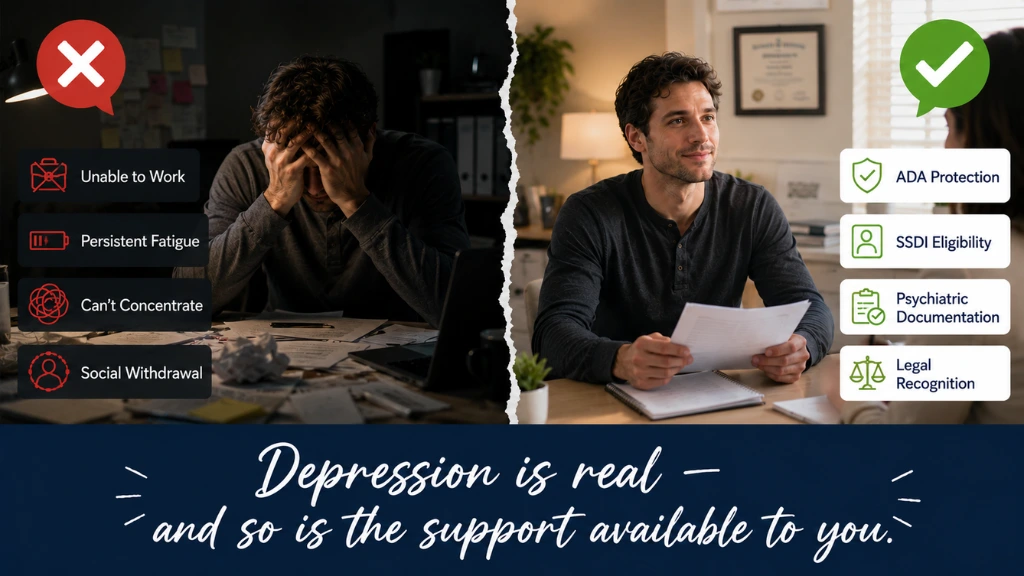
Is Depression Considered a Disability? For many people living with severe, persistent depression, this is not just a legal question — it’s a deeply personal one. The short answer is yes: depression can legally qualify as a disability under both the Americans with Disabilities Act (ADA) and the Social Security Administration (SSA). But the path from diagnosis to qualifying for protection or benefits involves specific criteria that are important to understand.
Is Depression Considered a Disability Under the ADA?
The Americans with Disabilities Act defines a disability as any physical or mental impairment that “substantially limits” one or more major life activities. Major life activities include working, sleeping, concentrating, caring for yourself, and interacting with others.
Depression — when severe enough — can affect every single one of those activities. That means individuals with clinical depression are legally protected under the ADA from discrimination in the workplace, in hiring, and in access to public services. This protection applies regardless of whether you are currently in treatment or whether your symptoms are currently managed.
It’s worth noting that ADA protection and qualifying for financial disability benefits are two separate things. Being protected under the ADA does not automatically mean you qualify for Social Security disability payments.
When Does Depression Qualify for Social Security Disability Benefits?
The Social Security Administration evaluates depression through a specific clinical lens. To meet their criteria, you must have a documented depressive disorder that includes at least five of the following symptoms:
- Persistent depressed mood
- Loss of interest or pleasure in most activities
- Significant changes in appetite or weight
- Sleep disturbances
- Fatigue or loss of energy
- Difficulty concentrating or making decisions
- Feelings of worthlessness or excessive guilt
- Psychomotor agitation or slowing noticeable to others
- Recurrent thoughts of death or suicide
Beyond symptoms, you must also demonstrate that depression significantly limits your ability to understand and process information, interact with others, maintain focus and pace, or manage yourself independently — in at least two of these areas.
Alternatively, if your depression is considered serious and persistent, with documented treatment and medical history spanning at least two years, and you have marked difficulty adapting to changes in your routine, you may also qualify under that pathway.
Knowing whether you meet these criteria starts with a thorough psychiatric evaluation and ongoing depression treatment — both of which are essential parts of the documentation process.
SSDI vs. SSI: Understanding the Difference
The SSA offers two primary financial assistance programs for people with disabilities:
Social Security Disability Insurance (SSDI) is available if you have a documented disability that has prevented you from working for at least 12 months and you have previously paid into Social Security through employment. Benefits are based on your prior earnings history.
Supplemental Security Income (SSI) does not require prior work history but is need-based — meaning you must demonstrate limited income and limited assets. Both programs can, in some cases, be received simultaneously.
A crucial detail: the SSA only recognizes total disability. Partial disability or short-term inability to work does not qualify. Your condition must significantly limit your ability to work for a minimum of 12 continuous months.
The Role of Psychiatric Documentation — and Why It Matters
This is where many disability applications succeed or fail. The SSA requires comprehensive, consistent medical documentation from licensed healthcare providers. That documentation must establish not just a diagnosis, but the severity and duration of your symptoms, how they limit your functioning, and the treatments that have been tried.
A psychiatrist — not just a primary care physician — carries significant weight in this process. Detailed psychiatric records showing the course of your illness, your treatment history, your response to medication management, and the functional limitations caused by your depression give your application the clinical foundation it needs.
If you’ve been struggling with depression and haven’t yet received a formal psychiatric evaluation, getting one is often the most important first step — both for your health and for any potential disability claim.
Can Treatment Affect Your Eligibility?
Yes — and in a nuanced way. The SSA expects to see that you are pursuing appropriate treatment. An untreated depression with no medical records is significantly harder to qualify under. Consistent, documented treatment demonstrates that your condition is genuine, ongoing, and being taken seriously.
At the same time, if treatment significantly reduces your symptoms and you are able to return to work, you may no longer qualify for disability benefits. The SSA periodically reviews cases to assess continued eligibility.
The goal at Bergen Psychiatric Associates is always your recovery and long-term well-being. But we also understand that for some patients, severe depression makes working impossible — and having proper psychiatric documentation and care is the foundation of any support you may need to pursue. Learn more about how we approach depression screening and treatment as part of comprehensive psychiatric care.
What If Your Application Is Denied?
Initial denials are common — a significant percentage of SSDI and SSI applications are rejected on the first submission. That doesn’t mean the process is over. You have 60 days from the denial to file a formal appeal. The appeals process has four levels, from reconsideration to federal civil court, and many applicants are ultimately approved during the appeals stage.
Working with a disability attorney — many of whom only charge fees if you win — can significantly improve your chances during the appeals process.
Frequently Asked Questions
Does having a depression diagnosis automatically qualify me for disability benefits?
No. A diagnosis alone is not enough. The SSA requires documented proof that your depression substantially limits your ability to work and function, typically for 12 months or longer.
Can I work while receiving SSI or SSDI for depression?
SSDI and SSI are for total disability, not partial. Returning to work may affect your benefits, and you are required to notify the SSA if your work status changes.
How does seeing a psychiatrist help my disability claim?
Psychiatric records — including evaluations, treatment history, medication trials, and functional assessments — are among the strongest forms of documentation accepted by the SSA when evaluating mental health disability claims.
If you or a loved one is struggling with depression and looking for professional psychiatric support in Bergen County, NJ, Bergen Psychiatric Associates is here to help. Dr. Syed Zaidi and our team offer comprehensive evaluations and personalized treatment plans in Fair Lawn, Hackensack, and Emerson, NJ.
Call 201-342-4004 or book your appointment online today.