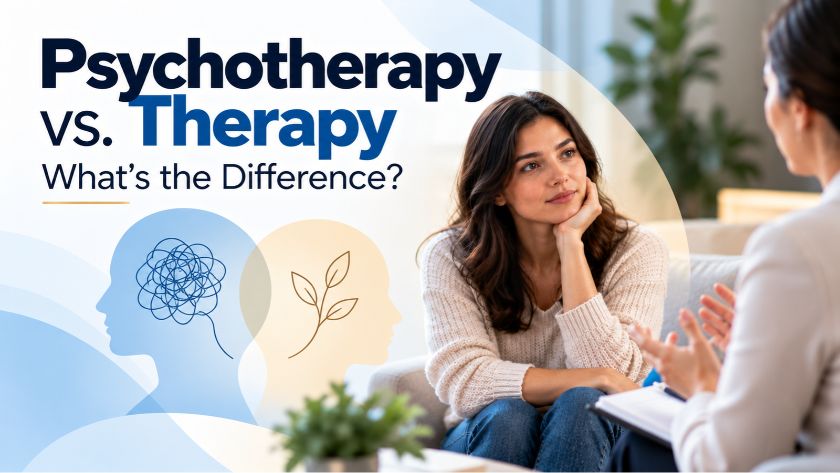
Broadly, therapy is a general term, while psychotherapy is a specific form of psychological treatment. Within mental health settings, people often use “therapy,” “psychotherapy,” and “talk therapy” to mean the same general type of care in everyday conversation.
There isn’t a universal rule that therapy is shorter, lighter, or less clinical than psychotherapy. What matters more is which professional, treatment method, and level of care fit the person’s needs. Some people may benefit from psychotherapy alone, while others may also need psychiatric evaluation, medication management, or another form of treatment based on symptoms, daily functioning, safety concerns, and treatment goals.
What Is Psychotherapy?
Psychotherapy is a group of psychological treatments that help people identify and change troubling thoughts, emotions, behaviors, or relationship patterns. The NIMH overview of psychotherapies describes psychotherapy, also called talk therapy, as treatment that may help with mental health symptoms, coping, daily functioning, and quality of life.
Care can be individual, couples, family, or group based. People don’t always need a psychiatric diagnosis before discussing stress, grief, relationship problems, life changes, or emotional difficulties with an appropriately qualified clinician.
What Does “Therapy” Mean?
As a word, therapy is broader. Depending on context, it can refer to psychotherapy, physical therapy, occupational therapy, speech therapy, respiratory therapy, or another treatment intended to improve a health condition.
Within mental health conversations, “therapy” usually means psychotherapy or counseling. Someone who says “I’m going to therapy” may simply mean they’re receiving psychotherapy from a mental health professional.
Psychotherapy vs. Therapy: What’s the Difference?
Within mental health care, there often isn’t a meaningful practical difference. Everyday usage makes “therapy” the broader term, while “psychotherapy” is the more specific clinical term for psychological treatment delivered by appropriately trained professionals using established therapeutic methods.
Neither word tells you how long treatment will last, how severe a condition must be, or whether the work will focus on the past or present. Those details depend on the treatment model, clinician, goals, symptoms, and individual situation.
|
Question |
Therapy |
Psychotherapy |
| Basic meaning | Broad term for treatment; in mental health, often shorthand for psychotherapy or counseling. | Specific psychological treatment delivered by appropriately trained mental health professionals. |
| Mental health use | Often used as an everyday label for psychotherapy or counseling. | More formal clinical term for psychological treatment. |
| Provider | Depends on the type of therapy and the professional’s credentials. | Provided by mental health professionals working within their training and legal scope. |
| Treatment methods | Varies widely because the term covers many kinds of treatment. | May include CBT, DBT, psychodynamic, interpersonal, exposure-based, supportive, family, couples, or group approaches. |
| Length | Can be brief or longer term. | Can be brief or longer term depending on goals, treatment model, and clinical needs. |
| Who may benefit | Depends on the kind of therapy being discussed. | People with mental health symptoms, coping difficulties, relationship concerns, grief, stress, or other appropriate treatment needs. |
| Medication included? | The word alone doesn’t tell you whether medication is part of care. | Psychotherapy itself isn’t medication prescribing, but it may be combined with medication management. |
Is Therapy the Same as Counseling?
Modern mental health care uses therapy, counseling, and psychotherapy with substantial overlap. Counselors may provide psychotherapy within the scope of their training and license, while another clinician may use the word counseling for a more focused type of support.
There isn’t a universal rule that counseling is always short term or only for mild concerns. Scope of practice depends on the professional’s credentials, training, treatment approach, and state law.
Who Can Provide Psychotherapy?
Different licensed mental health professionals may provide psychotherapy, depending on their training and legal scope of practice. “Therapist” is often used as a general label, but it isn’t the same thing as a specific professional license.
Relevant New Jersey licenses include psychologists, Licensed Professional Counselors, Licensed Clinical Social Workers, and Licensed Marriage and Family Therapists. Some psychiatrists also provide psychotherapy, although many psychiatric practices focus heavily on evaluation and medication management.
State boards regulate these professions separately. By state regulation, an LPC may provide counseling within the defined scope, an LCSW may provide clinical social work services, and marriage and family therapy is a specialized field of psychotherapy.
What Is the Difference Between a Psychologist and a Psychiatrist?
Psychologists typically have doctoral-level training in psychology and may provide psychotherapy, psychological assessment, or related services within their license and training. Practicing psychologists are separately licensed and regulated in New Jersey.
As physicians, psychiatrists specialize in mental health. They can evaluate psychiatric conditions and prescribe medication, and some also provide psychotherapy. Actual services vary by clinician and practice.
What Types of Psychotherapy Are Available?
Several established treatment approaches fall under psychotherapy. Method choice should depend on the concern being treated, available evidence, the clinician’s training, and the patient’s goals.
Common approaches include:
- Cognitive Behavioral Therapy, or CBT, which focuses on relationships among thoughts, emotions, and behaviors.
- Dialectical Behavior Therapy, or DBT, which uses structured skills and behavioral strategies for specific clinical needs.
- Psychodynamic therapy, which may examine recurring emotional and relationship patterns.
- Interpersonal therapy, which focuses on relationships and interpersonal functioning.
- Exposure-based therapies, which are used for certain anxiety and trauma-related conditions.
- Supportive, family, couples, group, and integrative approaches, depending on the treatment setting.
ZaidiMD’s psychotherapy services page currently references CBT, DBT, Rational Emotive Therapy, individual therapy, couples therapy, family therapy, and group therapy. Readers comparing care for anxiety can also review the practice’s anxiety treatment services, which describe psychotherapy and medication as possible parts of treatment.
What Happens During Psychotherapy?
Sessions don’t follow one universal script. Depending on the treatment approach and goals, sessions may involve discussing current concerns, identifying treatment goals, examining thoughts or emotions, recognizing behavior patterns, practicing coping strategies, or reviewing progress.
Many forms of psychotherapy are more structured than ordinary conversation. Depending on the method, treatment may include exercises, skills practice, behavioral tasks, exposure work, or between-session assignments.
What Happens at the First Psychotherapy Appointment?
First appointments usually focus on understanding why someone is seeking care and what they want help with. Clinicians may ask about current symptoms, mental health history, medical or medication history, daily functioning, relationships, safety, and treatment goals.
Exact processes vary by provider and setting. One appointment doesn’t always produce a final diagnosis or complete treatment plan.
How Long Does Psychotherapy Last?
Duration can be brief, time-limited, or longer term. Length depends on the concern, therapy model, severity, goals, progress, patient preference, and clinical circumstances.
APA guidance on psychotherapy notes that some people benefit from relatively brief treatment, while others need months or longer. That label doesn’t automatically mean years of treatment, and the word “therapy” doesn’t automatically mean short-term care.
Does Psychotherapy Work?
Evidence supports psychotherapy for many mental health conditions, but no treatment works equally well for every person. Outcomes depend on factors such as the condition being treated, therapy method, clinician expertise, treatment fit, patient preferences, engagement, severity, and the therapeutic relationship.
Strong working relationships between patients and clinicians also matter. People should be able to discuss goals, progress, concerns, and whether the treatment approach still fits their needs.
Psychotherapy vs. Medication: Which Do You Need?
Medication management and psychotherapy are different forms of care, and one isn’t universally better than the other. Some people receive psychotherapy alone, some receive medication alone, and others receive both.
Psychological and interpersonal methods are used in psychotherapy. Medication management involves psychiatric evaluation, prescribing when appropriate, monitoring response and side effects, and adjusting medication as needed.
At Bergen Psychiatric Associates, medication management is a separate service from psychotherapy. When appropriate, the psychotherapy team may coordinate with medication-management providers.
Does Starting Psychotherapy Mean You’ll Need Medication?
Not necessarily. Starting psychotherapy doesn’t mean medication will automatically be recommended.
Medication may be considered when symptoms, diagnosis, severity, prior treatment response, or other clinical factors support it. Psychiatric evaluation can help clarify whether medication should be part of the treatment plan.
How Do You Choose the Right Therapist or Treatment?
Everyday wording matters less than the clinician’s qualifications and treatment fit. Look for a provider whose license, training, and experience match the concern you want to address.
Useful factors include:
- Professional license and credentials
- Experience with the relevant concern
- Treatment approach
- Evidence supporting that approach
- Communication style and therapeutic fit
- Insurance and payment
- Telehealth or in-person availability
- Treatment goals
- Whether psychiatric evaluation or medication management may also be needed
Questions to Ask Before Starting Therapy
Several focused questions can make the choice clearer:
- What professional license do you hold?
- What experience do you have with my concern?
- What type of therapy do you use?
- What are the main treatment goals?
- How will we review progress?
- How often are sessions usually scheduled?
- Do you coordinate with psychiatric providers when medication evaluation is needed?
When Should You Consider Psychiatric Evaluation?
Psychiatric evaluation may be appropriate when symptoms are severe, significantly disrupt daily functioning, raise questions about medication, involve major changes in mood or behavior, or suggest psychosis or another condition that needs medical psychiatric assessment.
Evaluation can also be useful when symptoms may overlap with substance use, medication effects, or another medical issue. Its purpose is to clarify what kind of care may be appropriate, not to diagnose someone from a website article.
Urgent Mental Health and Safety Concerns
Routine psychotherapy isn’t a substitute for urgent crisis care. Anyone in the United States experiencing suicidal thoughts, a mental health crisis, or risk of harm can call or text 988 for immediate crisis support.
Call 911 or seek emergency medical care when there is immediate danger or a life-threatening emergency.
Psychotherapy at Bergen Psychiatric Associates
Bergen Psychiatric Associates and FairLawn Behavioral Associates provide psychotherapy through licensed professionals. Current practice information lists initial consultations, ongoing follow-up, individual therapy, couples therapy, family therapy, group therapy, CBT, DBT, Rational Emotive Therapy, and other individualized approaches.
Both practices also provide broader mental health services and medication management. Dr. Syed Zaidi, MD is the Medical Director and is board certified in psychiatry; his verified role includes diagnostic evaluations and medication management.
Current practice information describes psychotherapy appointments as very limited, so patients should call to check availability. Offices are listed in Fair Lawn, Emerson, and Hackensack, New Jersey.
To ask about psychotherapy availability, contact Bergen Psychiatric Associates or call 201-342-4004. Patients new to the practice can also complete the intake form, but submitting the form alone doesn’t create an appointment.
Frequently Asked Questions
Is psychotherapy the same as therapy?
Usually, in mental health care, yes. Broadly, “therapy” covers more, but people often use it as shorthand for psychotherapy or counseling.
What is the main difference between therapy and psychotherapy?
As a word, therapy is broader. More specifically, psychotherapy refers to psychological treatment provided by a trained mental health professional.
Is counseling considered psychotherapy?
It can be. Counseling and psychotherapy overlap, and whether a counselor provides psychotherapy depends on their license, training, scope of practice, and treatment approach.
Do you need a diagnosis for psychotherapy?
No. People can seek psychotherapy for stress, grief, relationship problems, life changes, coping difficulties, or mental health symptoms without already having a formal diagnosis.
Can a psychiatrist provide psychotherapy?
Yes. Psychiatrists are physicians who can provide psychotherapy, although many also focus on psychiatric evaluation and medication management.
Does psychotherapy involve medication?
No. The treatment itself doesn’t involve prescribing medication, but some patients receive psychotherapy and medication management as part of the same overall treatment plan.
Is psychotherapy always long term?
No. It may be brief, time-limited, or longer term depending on the treatment approach, goals, symptoms, and clinical needs.
Which is better, therapy or psychotherapy?
Neither is universally better because the terms often overlap. Fit depends on the clinician’s qualifications, treatment method, and the person’s needs.
Can psychotherapy help with anxiety or depression?
Yes, psychotherapy is an established treatment option for anxiety and depression. Specific treatment and medication needs depend on the individual clinical situation.
When should I see a psychiatrist instead of a therapist?
Consider a psychiatrist when medication, diagnostic clarification, severe symptoms, psychosis, or major changes in mood or behavior may require medical psychiatric evaluation.