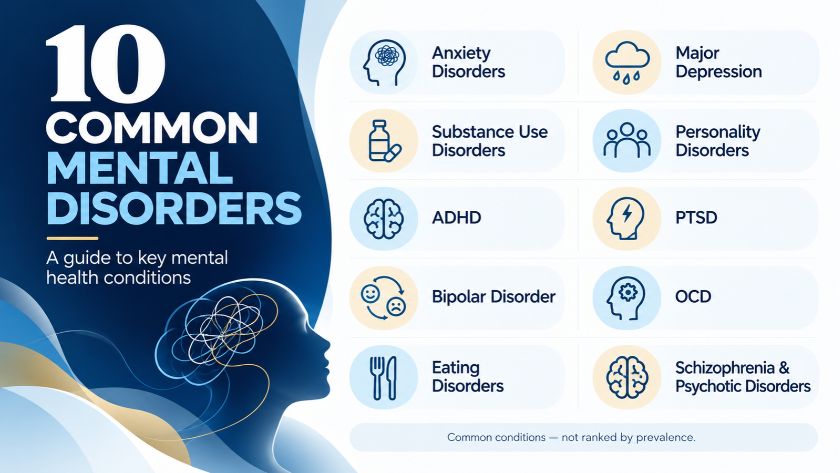
There isn’t one current U.S. dataset that can rank every mental disorder from first through tenth using the same age group, diagnostic method, and time period. Some surveys measure broad diagnostic categories, some report individual disorders, and others track recent symptoms rather than diagnoses.
Because the available datasets differ, the ten conditions below are presented as commonly occurring mental disorders or diagnostic groups, not as a precise prevalence ranking. Numbering them would suggest false precision, so the list is organized without a prevalence rank. The 2025 National Survey on Drug Use and Health estimated that 20.6% of U.S. adults had any mental illness in the past year, but federal surveys don’t measure every condition in exactly the same way. NIMH mental health statistics also draw on several studies with different populations and timeframes.
What Is a Mental Disorder?
A mental disorder is a clinically significant disturbance in thinking, emotional regulation, or behavior that causes distress or interferes with daily functioning. Diagnosis depends on the pattern, duration, severity, and effect of symptoms, not on one difficult day or one isolated behavior.
Sadness isn’t automatically depression. Worry isn’t automatically an anxiety disorder, and trouble concentrating doesn’t automatically mean ADHD. Clinicians look at the full picture, including medical conditions, medications, substance use, personal history, and how symptoms affect work, school, relationships, sleep, or self-care.
What Are the Ten Most Common Mental Disorders?
These disorders and diagnostic groups repeatedly appear in U.S. prevalence research and clinical statistics. Their exact prevalence can’t be compared as a single league table because the best available estimates come from different datasets and sometimes different age ranges.
Anxiety Disorders
Anxiety disorders involve fear, worry, or physical anxiety that is persistent, difficult to control, or out of proportion to the situation. Examples include generalized anxiety disorder, panic disorder, social anxiety disorder, and specific phobias.
Common signs can include excessive worry, restlessness, muscle tension, racing thoughts, panic attacks, avoidance, sleep problems, and difficulty concentrating. Feeling nervous before a presentation or during a stressful week doesn’t by itself mean someone has an anxiety disorder.
Care may include psychotherapy, medication for some patients, and behavioral strategies matched to the specific condition. ZaidiMD’s anxiety treatment options describe evaluation and treatment approaches for patients with persistent anxiety symptoms.
Major Depressive Disorder
Major depressive disorder, often called clinical depression, involves a persistent depressed mood and/or loss of interest or pleasure along with other symptoms that affect daily functioning. Diagnostically, a major depressive episode generally lasts at least two weeks, though the number and severity of symptoms and possible alternative explanations also matter.
Possible symptoms include low mood, loss of interest, fatigue, sleep or appetite changes, slowed or restless behavior, difficulty concentrating, feelings of worthlessness or excessive guilt, and thoughts of death or suicide. Temporary sadness after a setback doesn’t automatically meet the criteria for major depressive disorder.
SAMHSA’s 2025 survey estimated that 7.4% of U.S. adults had a major depressive episode in the past year. Depression treatment may include psychotherapy, antidepressant medication, or other approaches based on the person’s symptoms, history, preferences, and clinical needs.
Substance Use Disorders
A substance use disorder involves a problematic pattern of alcohol or drug use that causes clinically significant impairment or distress. It can affect health, relationships, work, school, judgment, and the ability to meet responsibilities.
Signs vary by substance and severity. They may include difficulty cutting down, strong cravings, continued use despite harm, spending substantial time obtaining or using the substance, tolerance, withdrawal, or giving up important activities.
In 2025, SAMHSA estimated that 15.3% of people age 12 or older in the United States had a substance use disorder in the past year. Options can include counseling, medications for certain substance use disorders, recovery supports, and care for co-occurring psychiatric conditions. ZaidiMD’s addiction treatment services describe outpatient help for substance-related concerns.
Personality Disorders
Personality disorders involve enduring patterns of thinking, feeling, and behaving that differ markedly from cultural expectations and cause distress or problems with functioning. These patterns are persistent rather than brief reactions to a stressful event.
Examples within this category include borderline, avoidant, and obsessive-compulsive personality disorders. Obsessive-compulsive personality disorder is not the same condition as obsessive-compulsive disorder, despite the similar name.
Psychotherapy is commonly used in treatment, and care may also address depression, anxiety, substance use, or other co-occurring problems. Medication can be used for specific symptoms or co-occurring conditions, but there isn’t one medication treatment that fits every personality disorder.
Attention-Deficit/Hyperactivity Disorder
Attention-deficit/hyperactivity disorder, or ADHD, is a neurodevelopmental disorder involving persistent patterns of inattention and/or hyperactivity and impulsivity that interfere with functioning. ADHD symptoms begin during development and can continue into adulthood.
Adults may struggle with organization, time management, sustained attention, forgetfulness, impulsive decisions, or restlessness. Those problems also occur for many other reasons, so concentration difficulty by itself isn’t enough for an ADHD diagnosis.
Care can include medication, behavioral strategies, skills-based support, and psychotherapy when appropriate. The practice’s ADHD treatment page explains how evaluation and treatment may be approached for children and adults.
Post-Traumatic Stress Disorder
Post-traumatic stress disorder, or PTSD, can develop after exposure to actual or threatened death, serious injury, sexual violence, or other qualifying trauma. Experiencing trauma doesn’t automatically mean a person will develop PTSD.
Possible features include intrusive memories or nightmares, avoidance of reminders, changes in mood or beliefs, feeling detached, irritability, hypervigilance, sleep problems, and a heightened startle response. For a PTSD diagnosis, these symptoms must form a clinically significant pattern rather than a short-lived stress reaction.
Trauma-focused care often includes psychotherapy, and medication may be considered for some people. Readers trying to understand reactions after a difficult event may also find the practice’s guide to signs of emotional trauma in adults useful.
Bipolar Disorder
Bipolar disorder involves episodes of abnormal changes in mood, energy, activity, and functioning. It isn’t simply ordinary moodiness or switching between feeling happy and sad.
A Bipolar I diagnosis requires at least one manic episode. For Bipolar II disorder, the history includes at least one hypomanic episode and at least one major depressive episode, with no history of a full manic episode.
Bipolar care depends on the type of bipolar disorder, the current episode, previous response, medical history, and safety considerations. It may include mood-stabilizing medication, certain antipsychotic medications, psychotherapy, or other treatments. ZaidiMD’s article on understanding bipolar disorder provides more detail about symptoms and treatment.
Obsessive-Compulsive Disorder
Obsessive-compulsive disorder, or OCD, involves obsessions, compulsions, or both. Obsessions are unwanted, intrusive thoughts, urges, or images, while compulsions are repetitive behaviors or mental acts a person feels driven to perform.
OCD can consume significant time and interfere with work, school, relationships, or daily routines. Liking order, checking a door once, or having a repeated habit doesn’t automatically mean someone has OCD.
Common approaches include cognitive behavioral therapy with exposure and response prevention, medication for some patients, or a combination of approaches. Evaluation is useful when intrusive thoughts or repetitive behaviors are difficult to control or are disrupting daily life.
Eating Disorders
Eating disorders are psychiatric conditions involving significant disturbances in eating behavior and related thoughts or emotions. They can affect people of different body sizes, ages, and genders and can also cause serious medical complications.
Examples include anorexia nervosa, bulimia nervosa, and binge-eating disorder. Warning signs vary by condition and may involve restrictive eating, recurrent binge eating, compensatory behaviors, intense fear of weight gain, or persistent preoccupation with food, weight, or body shape.
Eating-disorder care may require coordinated medical, nutritional, and mental health care. Care planning depends on the eating disorder, medical stability, co-occurring conditions, and individual needs.
Schizophrenia and Other Psychotic Disorders
Schizophrenia is a chronic psychiatric disorder that can affect thinking, perception, emotion, behavior, and functioning. Possible symptoms include hallucinations, delusions, disorganized thinking, reduced emotional expression, low motivation, and cognitive difficulties.
Psychosis isn’t synonymous with schizophrenia. Psychotic symptoms can occur in several psychiatric or medical conditions, and a careful evaluation is needed to identify the cause.
Schizophrenia care commonly includes antipsychotic medication and psychosocial care. Early, coordinated treatment can address symptoms, functioning, education or employment, family support, and other needs.
Can Someone Have More Than One Mental Health Disorder?
Yes. One person can meet criteria for more than one mental health disorder, a situation often called comorbidity. For example, anxiety and depression can occur together, and substance use disorders can occur alongside mood, anxiety, trauma-related, or psychotic disorders.
Overlapping symptoms can make evaluation more complicated. Sleep problems, poor concentration, irritability, and low energy occur in several conditions, so clinicians look at timing, context, duration, and the relationship among symptoms rather than assigning a diagnosis from one symptom.
How Are Mental Disorders Diagnosed?
Mental disorders are generally diagnosed through a clinical evaluation, not a single blood test, brain scan, or online quiz. Screening questionnaires can identify symptoms that deserve attention, but they don’t replace a diagnostic assessment.
Evaluation may include:
- Current symptoms and how long they’ve been present
- Changes in work, school, relationships, sleep, or self-care
- Past psychiatric symptoms or diagnoses
- Medical conditions and medications
- Alcohol and drug use
- Family psychiatric history
- Previous treatment and medication responses
- Information from family or other people, when appropriate and with proper consent
The goal is to understand the pattern and rule out other explanations. Mental health services at Bergen Psychiatric Associates include evaluation and treatment for a range of psychiatric concerns.
How Are Mental Health Disorders Treated?
Appropriate care depends on the diagnosis, symptom severity, medical history, patient preferences, safety concerns, and co-occurring conditions. There isn’t one treatment plan that applies to every disorder on this list.
Depending on the condition, care may include:
- Psychotherapy services
- Psychiatric medication management
- Behavioral or skills-based interventions
- Education and support for patients and families
- Lifestyle support involving sleep, activity, and daily routines
- Treatment for substance use or other co-occurring conditions
- Coordination with medical or other mental health professionals
Some people benefit from one form of treatment, while others need a combination. Medication isn’t necessary for every disorder, and psychotherapy alone isn’t the right plan for every patient.
When Should You Talk to a Mental Health Professional?
Professional evaluation may be useful when symptoms persist, cause significant distress, or interfere with work, school, relationships, sleep, self-care, or everyday responsibilities. Recurring episodes, risky behavior, major changes in energy or sleep, substance-related problems, intrusive thoughts, disordered eating, or possible psychotic symptoms also deserve clinical attention.
Urgent help is appropriate when someone is in immediate danger, has suicidal thoughts, is at risk of harming someone, or is experiencing severe symptoms that make it difficult to stay safe. In the United States, call or text 988 for the Suicide & Crisis Lifeline. Call 911 for a life-threatening emergency.
Mental Health Care at Bergen Psychiatric Associates
Bergen Psychiatric Associates and Fair Lawn Behavioral Associates provide psychiatric care for a range of mental health conditions. Dr. Syed Zaidi, MD is board certified in psychiatry and serves as Medical Director of both practices.
Services listed on ZaidiMD include psychiatric evaluation, medication management, psychotherapy, ADHD treatment, anxiety treatment, depression treatment, and addiction assistance. Practice locations listed on the website include Hackensack, Emerson, and Fair Lawn, New Jersey.
To ask about appointment availability, contact Bergen Psychiatric Associates or call 201-342-4004. Completing an intake form alone doesn’t create an appointment, so the website instructs new patients to call the office.
Frequently Asked Questions
What is the most common mental disorder?
Anxiety disorders are among the most common mental health conditions in U.S. prevalence research, but an exact number-one ranking depends on which disorders are grouped together, the age group studied, and the time period measured. Different federal and research datasets don’t measure every diagnosis in the same way.
What are the main types of mental disorders?
Major diagnostic groups include anxiety disorders, depressive disorders, bipolar and related disorders, trauma-related disorders, obsessive-compulsive and related disorders, neurodevelopmental disorders such as ADHD, substance use disorders, eating disorders, personality disorders, and schizophrenia spectrum or other psychotic disorders.
Can a person have more than one mental health disorder?
Yes. More than one mental health disorder can occur at the same time. Clinicians evaluate how symptoms overlap and whether one condition, several conditions, a medical problem, medication effects, or substance use better explains the person’s experience.
How are mental disorders diagnosed?
Diagnosis usually involves a clinical interview and review of symptoms, duration, severity, functioning, medical history, medications, substance use, and previous episodes. Screening tools can support the process, but no online checklist can reliably diagnose all mental disorders.
Can mental health disorders be treated?
Many mental health disorders can be treated, but the appropriate approach varies by condition and person. Options may involve psychotherapy, medication, behavioral interventions, support for daily functioning, substance use treatment, or coordinated care for medical and psychiatric needs.
When should someone see a psychiatrist?
Consider a psychiatric evaluation when symptoms are persistent, severe, recurring, difficult to explain, or interfering with daily life. Psychiatric evaluation may also help when medication decisions, possible bipolar or psychotic symptoms, substance use, diagnostic uncertainty, or several overlapping conditions require medical assessment.